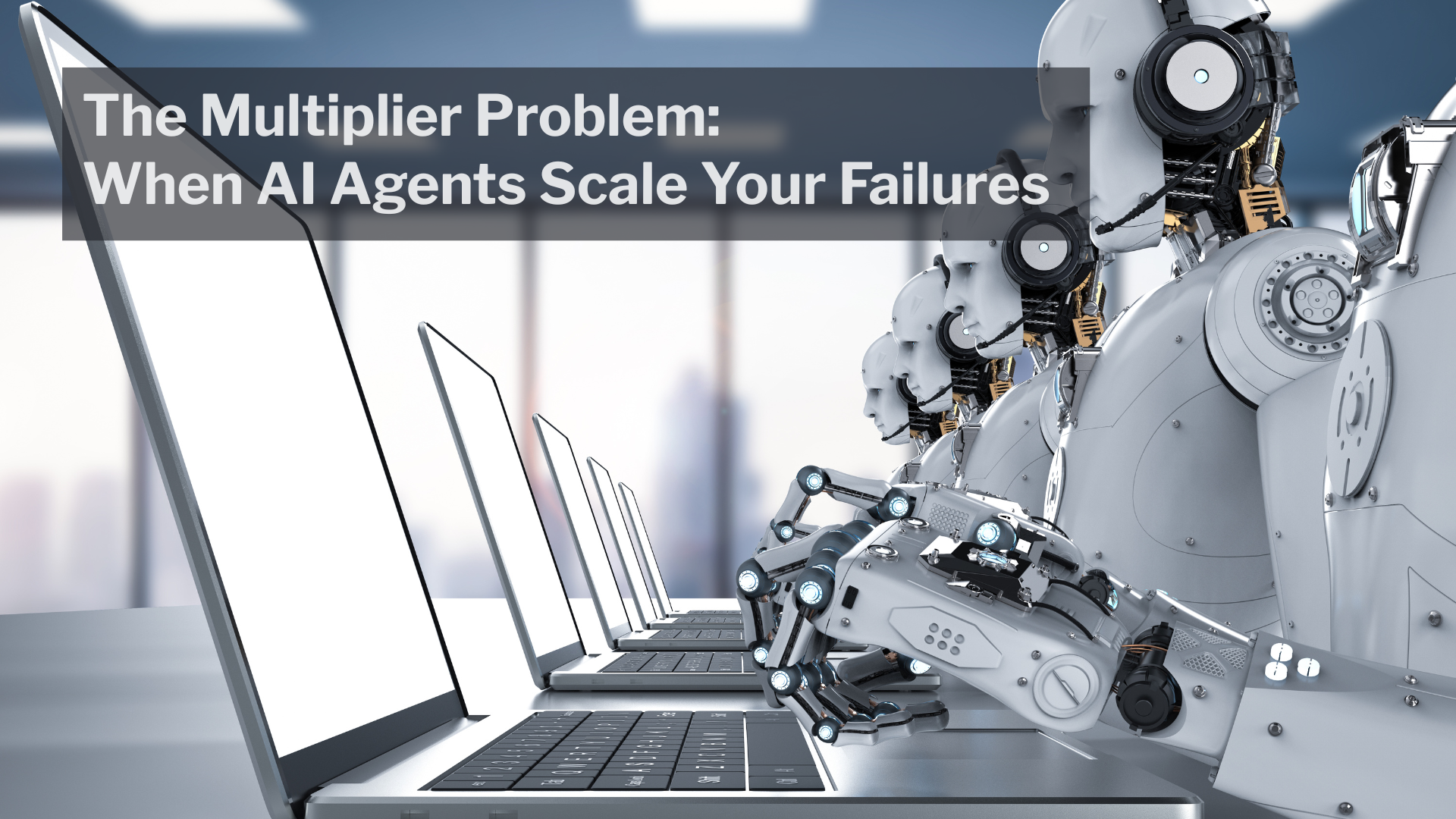
The Multiplier Problem: When AI Agents Scale Your Failures
A few weeks ago, I wrote about why AI agents fail in production. The core argument was simple: agents fail because they have autonomy without context. They can take actions with real consequences, but they lack the explicit boundaries that make those actions safe. (See the article “The Context Problem: Why AI Agents Fail in Production“.)
Since then, the conversation around AI agents has shifted. The new framing is “workforce multiplier.” The pitch goes like this: AI agents don’t just assist workers; they multiply their output. One person with the right agents can do the work of ten. Teams can scale without hiring. Entire functions can be automated while humans focus on higher-value work.
The pitch isn’t wrong. Agents genuinely can multiply output. But multiplication is agnostic to what’s being multiplied. An agent that multiplies good decisions also multiplies bad ones. An agent that scales productivity also scales errors. An agent that amplifies human capability amplifies human blind spots.
The workforce multiplier thesis assumes that what’s being multiplied is value. Without context architecture, what actually gets multiplied is risk.
The Promise
Let’s be fair about what’s being offered. The workforce multiplier thesis isn’t fantasy. Real capability exists here.
Knowledge workers spend enormous amounts of time on tasks that don’t require their full judgment. Research, summarization, drafting, formatting, scheduling, data entry, routine analysis. These tasks aren’t trivial, but they’re also not where human expertise creates the most value. Agents can handle much of this work, freeing humans to focus on decisions, relationships, and creative problem-solving.
The productivity research supports this. Studies show meaningful output gains when AI assists knowledge work. Some firms report that work previously requiring large teams can now be accomplished by much smaller groups with agent support. The efficiency is real.
The economic logic follows naturally. If agents multiply individual output, organizations can accomplish more with fewer people, or accomplish dramatically more with the same people. Either path leads to competitive advantage. The organizations that figure this out first win. The ones that don’t get left behind.
This is the story being told in boardrooms and investor presentations. It’s compelling because it’s partially true.
The Inversion
Here’s what the pitch leaves out: every promised benefit has a shadow version that emerges when agents operate without proper context.
Productivity gains become error multiplication. An agent processing customer requests faster also processes them incorrectly faster. An agent drafting documents at scale produces flawed documents at scale. An agent that handles ten times the volume makes ten times the mistakes. When humans were the bottleneck, human judgment caught problems before they compounded. When agents remove that bottleneck, errors flow downstream unchecked.
Efficiency gains become accountability vacuums. When one person manages work that used to require ten, who’s responsible for the quality of that work? The human can’t meaningfully review everything the agents produce. The agents aren’t accountable in any organizational sense. The efficiency gain creates a gap where no one owns the outcomes. Problems emerge later, often much later, when tracing them back to their source has become difficult or impossible.
Scale becomes risk amplification. A human making a bad judgment call affects one client, one project, one decision. An agent making the same bad call affects every client, every project, every decision it touches. The scale that makes agents valuable is the same scale that makes their failures catastrophic. Small errors don’t stay small when they’re replicated thousands of times.
Speed becomes invisible failure. Human workers make mistakes visibly. They hesitate, ask questions, flag uncertainty. Agents execute confidently regardless of whether they’re right. They complete tasks successfully even when the completed task is wrong. The speed that looks like productivity often masks problems that won’t surface until the damage is done.
None of this means agents are bad or that the workforce multiplier thesis is false. It means the thesis is incomplete. Multiplication requires something worth multiplying. Without context architecture, you’re multiplying chaos.
What Multiplication Actually Requires
In my previous article, I argued that agents need explicit context to operate safely. Context answers three questions: What should happen (business objectives and priorities)? What must not happen (policies and constraints)? What can happen (technical realities and limitations)?
The workforce multiplier framing makes these questions more urgent, not less. When agents operated as assistants handling discrete tasks, context gaps caused localized problems. When agents operate as workforce multipliers handling broad responsibilities at scale, context gaps cause systemic failures.
Think about what it means for an agent to multiply a worker’s output. The agent isn’t just completing tasks; it’s making judgments about priorities, quality thresholds, exception handling, and escalation. It’s operating with the kind of autonomy that humans develop over years of experience and organizational socialization. It’s exercising discretion constantly, in ways that matter.
That discretion has to come from somewhere. Either it comes from explicit context (defined operating envelopes, clear policies, specified escalation paths) or it comes from inference (the agent’s best guess about what’s appropriate based on training data and pattern matching). Inference works in demos. It fails at scale, in exactly the ways I described before.
The workforce multiplier thesis actually strengthens the case for context architecture. If agents are going to operate with this much autonomy at this much scale, the need for explicit boundaries becomes more critical, not less. The paramedic model I described before (significant autonomy within defined protocols) isn’t optional when you’re multiplying output. It’s the only thing that makes multiplication safe.
Two Futures
Let me make this concrete. Consider a professional services firm (consulting, legal, accounting; the specifics matter less than the pattern) deciding to deploy AI agents as workforce multipliers. Leadership has seen the research on productivity gains. Competitors are making moves. The pressure to act is real.
The firm has the same choice every organization faces: deploy broadly and figure out context later, or build context architecture first and deploy within defined boundaries.
Here’s how each path plays out.
Future A: The Fast Path
The firm deploys capable agents across its practice areas. Associates get AI assistants that can research, draft, analyze, and summarize. The agents have access to client files, internal knowledge bases, and relevant databases. The mandate is broad: help associates be more productive.
Initial results look promising. Associates complete work faster. Utilization metrics improve. Partners see preliminary evidence that fewer associates might handle the same workload. The deployment is declared a success.
Problems emerge slowly.
An agent researching case law for a litigation matter returns confidently wrong precedents. The associate, trusting the agent’s output and under time pressure, doesn’t verify every citation. The brief goes out with errors that opposing counsel catches. The client is embarrassed. The partner is furious. But this looks like an isolated incident; the associate should have checked.
An agent drafting client communications uses language that’s technically accurate but tonally wrong for a sensitive situation. Multiple similar communications go out before anyone notices the pattern. A client relationship sours over what feels like impersonal treatment. But this looks like a training issue; associates need to review outputs more carefully.
An agent analyzing financial documents flags routine transactions as concerning while missing an actual anomaly buried in the data. The team spends hours investigating false positives and develops alert fatigue. When a real problem surfaces months later, the warning signs were in documents the agent processed. But this looks like a limitation of the technology; AI isn’t perfect.
Each incident is explained away individually. The aggregate pattern (agents exercising discretion they weren’t equipped to exercise) remains invisible because no one’s looking at the system level. The firm has multiplied its output. It has also multiplied its exposure.
Eighteen months in, a significant failure occurs. The specifics vary (a compliance issue missed, a client matter mishandled, a confidentiality breach, a regulatory problem), but the pattern is consistent. The agents operated outside appropriate boundaries because no boundaries were defined. The failure compounds because scale meant the error propagated widely before detection. The accountability is unclear because the human-agent responsibilities were never specified.
The firm responds by pulling back on agent deployment, implementing hasty constraints, and absorbing reputational damage. The workforce multiplier promise has delivered its shadow version: problems multiplied faster than value.
Future B: The Deliberate Path
The firm makes a different choice. Before broad deployment, they invest in context architecture.
They start by mapping decision types. What judgments do associates actually make in the course of their work? Some are routine (formatting, citation style, document organization). Some require domain expertise (legal analysis, regulatory interpretation, strategic recommendations). Some involve client relationships (tone, sensitivity, escalation). Each type has different requirements for agent involvement.
They define operating envelopes for each decision type. Agents can handle routine tasks autonomously. Domain expertise tasks require agent assistance with human verification. Client relationship tasks require human judgment with agent support. The boundaries are explicit, documented, and built into the deployment.
They establish escalation paths. When an agent encounters something outside its envelope (an unusual fact pattern, a potential conflict, a sensitive client situation), it flags for human review rather than proceeding with its best guess. The escalation thresholds are calibrated based on risk, not just agent confidence.
They assign context ownership. Specific people are responsible for maintaining the operating envelopes in each practice area. When policies change, when client relationships evolve, when new matter types emerge, someone owns updating the context the agents operate within.
They build feedback loops. Agent outputs are sampled and reviewed. Errors are traced back to context gaps. Operating envelopes are adjusted based on actual performance. The system learns, but through deliberate human oversight rather than unconstrained agent adaptation.
Initial deployment is slower. Associates complain about constraints. Partners question why competitors seem to be moving faster. The productivity gains are real but modest compared to the breathless projections.
Then the compounding starts.
Because agents operate within defined boundaries, errors are caught at boundaries rather than propagating through the system. Because escalation paths exist, edge cases get human judgment instead of confident wrong answers. Because context is maintained, agent behavior stays aligned with firm practice as circumstances change.
Eighteen months in, the firm has agents handling substantial volume reliably. The associates who work with agents have developed new skills: defining requirements clearly, evaluating agent outputs efficiently, maintaining context as matters evolve. The human-agent collaboration has become a genuine capability rather than a hopeful experiment.
The workforce multiplier promise has delivered its intended version: sustainable productivity gains built on a foundation of bounded autonomy.
The Choice
These two futures aren’t equally likely. The fast path is easier, more tempting, and more aligned with how organizations typically adopt new technology. The deliberate path requires upfront investment, organizational patience, and capabilities most firms haven’t built.
But the outcomes aren’t equally distributed either. The organizations that treat workforce multiplication as a context problem (not just a deployment problem) will build something sustainable. The ones that don’t will cycle through enthusiasm, failure, and retrenchment.
The technology works. The question is whether your organization is ready to use it at the scale you’re contemplating. Multiplication is powerful. It’s also unforgiving. What you’re multiplying matters more than how fast you’re multiplying it.
The firms that figure this out will have genuine competitive advantage. Not because they adopted AI first, but because they adopted it in a way that compounds rather than collapses.
The multiplier problem isn’t whether AI can multiply your workforce. It can. The problem is making sure what gets multiplied is worth multiplying.